> For the complete documentation index, see [llms.txt](https://en.jego.pro/llms.txt). Markdown versions of documentation pages are available by appending `.md` to page URLs; this page is available as [Markdown](https://en.jego.pro/user-guide/proxy-strategy.md).
# Proxy Strategy
Setting up a proxy strategy can allow foreign websites to be automatically routed through the proxy, while domestic video sites are not routed through the proxy, and so on.
## Configuration Rules
{% hint style="danger" %}
Notice for Mainland China Users
Jego's Rule mode has pre-configured almost all commonly used websites and IP addresses in mainland China. No need to add these websites to direct connection rules during daily use.
{% endhint %}
In Jego Control Panel, click on "Proxy Strategy" in the left navigation bar, and then click "Add Proxy Strategy".
{% hint style="info" %}
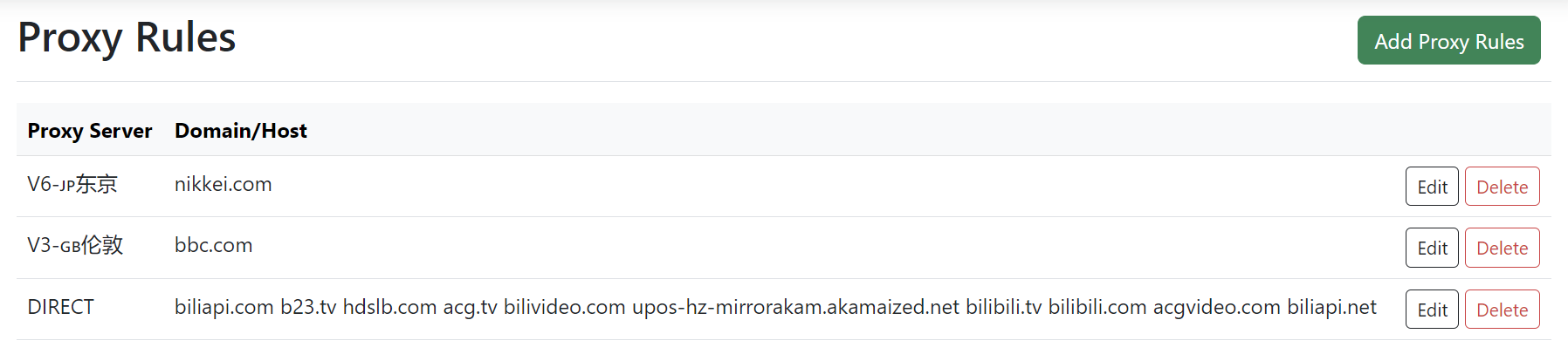
As an example, let's configure Jego to access BBC via the London node, access Nikkei Chinese website via the Tokyo node, and access Bilibili without going through the proxy.
{% endhint %}
1. Select the London node as the Proxy Server for accessing BBC.
2. Enter bbc.com in the Domain/Host List (use comma and space to separate multiple domains if any) and click Save.
3. Add another Proxy Policy and select the Tokyo node as the Proxy Server for accessing Nikkei Chinese website.
4. Enter nikkei.com in the Domain/Host List (use comma and space to separate multiple domains if any) and click Save.
5. Add another Proxy Policy and select Direct \[No Proxy] as the Proxy Server for accessing Bilibili without using proxy.
6. Enter acg.tv, acgvideo.com, b23.tv, bilibili.com, bilibili.tv, biliapi.net, biliapi.com, bilivideo.com, hdslb.com, upos-hz-mirrorakam.akamaized.net in the Domain/Host List and click Save.
After successful configuration, when using Jego in Rules mode, Bilibili will be directly connected, bbc.com and \*.bbc.com will be routed through the London server, and nikkei.com and \*.nikkei.com will be routed through the Tokyo server.
## Efficient and practical
With properly set rules, you can enjoy both domestic and international online resources more smoothly.